The Greeks
Greeks are an integral part of options trading and no we are not talking about the Greeks from history sadly despite the article picture. Think of Greeks as almost a sportsbook in the sense that this is what the house thinks of this certain options contract and this is how it moves when the underlying(athlete) performs. Sportsbooks will give you odds based on the way they think the certain game will play out if there is a heavy favorite you will not win as much and vice versa. Sportsbooks price it in on a spread just like options do and honestly this is a common thing in the sense of comparing sportsbooks to financial instruments like options. Okay so what exactly is a Greek and why should you care? Greeks are calculated metrics that show the trader/user how risky the options contract is. Greeks consist of five measures mainly being delta, gamma, theta, vega, and rho and these are usually displayed when you view an options contract. Now let's dive into these and really understand them at a surface level and apply them in the real market. Before I start breaking down the Greeks just want to put a disclaimer of Greeks can have multiple purposes, I will just be covering the broad purposes for each one. Delta is the metric that lets you know how much your options contract will change per a dollar move in the underlying (equity that you are trading options on) and delta is usually the first Greek I look at as this will give me a rough estimate on 1. how much will my contract go up if the underlying hits my price target (excluding gamma) and 2. are my odds good as delta can also act as a percent measure for your contract finishing in the money. Gamma is deltas partner I would say as this is pretty much the rate at which delta moves for every one dollar change in the underlying. Delta and Gammas relationship is very variable as when the underlying moves they both moved showing that delta is not a fixed number and will change based on underlying movement. Next up in my eyes is the one that throws people off the most not because of it being confusing but the fundamental theory behind it. Theta is a non-linear time decay behind your option essentially how much money are you losing per day if all else stays the same. Theta makes a contract lose value over time which is why it is one of the most important Greeks. Honestly theta can have a whole write up of its own, but it is very important that you acknowledge the threat of theta decay when trading options as it speeds up the closer you get to the options expiration date. Theta as stated earlier can be very dangerous for the buyer and this article is more focused on the Greeks for the buyer, but theta is extremely important for the seller just to be noted. Vega is the measure of the delta in the option price per one percent change in volatility. Longing Vega can be very beneficial if you have a high volatility sentiment for a particular underlying asset and you can make significant gains from the rise in Vega even if the underlying doesn't move which is a concept alot of people do not know. Vega decay is also a factor as the closer to expiration the more Vega will decay but further out the Vega will remain more solid relative to closer expiration contracts. Rho is kind of the odd one out as it is usually overlooked but it is still valuable to be talked about as it is the sensitivity to interest rates on that contract. Interest rates in this case usually refers to the current risk-free rate (U.S. T-Bills and Bonds) hinting these are essentially risk free. Risk free rates are usally lower due to the nature of no risk which would naturally drive the market rate down so when this change rho will factor into your option contract. Rho is very important if you are expecting long term interest rate changes and it is not really that helpful in the short term. Greeks are very important for the buyer/seller and if you do not know how to read these and relate them to current environment things can go south really quick.
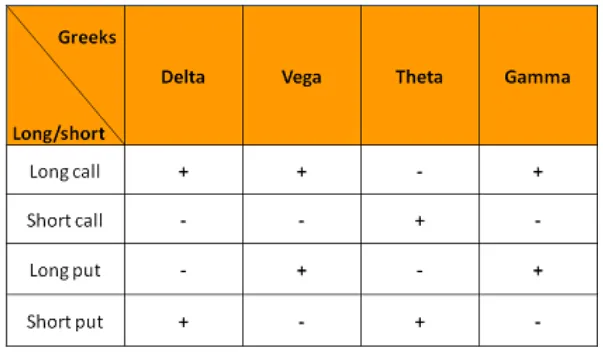
Above is a chart that implies the values for the Greeks listed and how they are measured per each type of option. Signs in front of the respected Greek will show you how they move when the underlying moves that are related to the underlying (Delta and Gamma) and Greeks related to extrinsic factors (Theta and Vega) will move when their respected factor changes. Greeks are just mathematical sensitivities that state current market traits so it is important to not just rely on these, Extrinsic events are always a possibility, and the Greeks cannot price that in so acknowledge them but do not rely on them fully for your trade.